
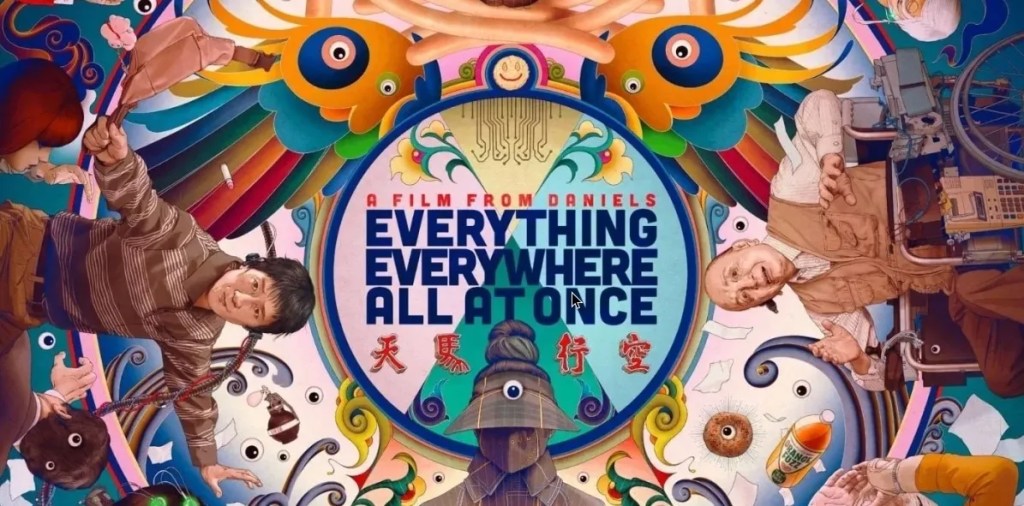
‘Everything, Everywhere, All at Once’ (EeAaO) is a masterpiece, the above title aside. This film wholistically breaks nearly every barrier of filmmaking that has been drawn since the turn of the century, but the metaphorical diamonds in the rough aren’t found in the plot, it lies in theme and timing. EeAaO, has just been named A24’s most successful box office film, giving the little indie studio that could the kick it needed to demonstrate the power in its one-of-a-kind content.
A24, becoming more and more of a household name, lacks longevity to support the content that other studios are striving for: Hulu, Amazon Prime Video, and HBO Max. However, A24 firmly stands with the support of cinemas and theaters rather than streaming services, a commendable mission as of recent; but with more hit movies being made by the indie studio, they must decide between exclusivity or longevity. A24 and its many releases are synonymous with that of other studios’ decision-making process on giving the green light to produce or distribute. EeAaO was a different beast. That difference is what led to the film’s box office success but provides A24 an opportunity too good to pass up.
In 1998, Peter Howitt gave us ‘Sliding Doors’ starring Gwyneth Paltrow, which explored two variations of life-based off a single decision: more “Butterfly Effect” than multiple universes. Since then, Hollywood has tackled sci-fi themes of time travel, multiple dimensions, and multiple universes as a grey area of thematic ideation rather than pick one and run with it, until now. Why has Marvel and Disney profited so heavily off multiverses while no one seems to be touching it? For example, in 2018 Sony released the animated hit: ‘Spider-Man: Into the Spider-verse, followed by a post-pandemic blockbuster, ‘Spider-man No Way Home’ and to be followed not six months later by another Marvel blockbuster ‘Doctor Strange: Multiverse of Madness’. Within this six-month period, A24 had the balls (excuse the euphemism) to tiptoe around Disney’s multiversal monopoly, smack dab in the middle between the two biggest releases since the beginning of the pandemic.

It was this risk-taking by A24 management that really led to the film’s success, but it wasn’t the only thing. There is a distinct shift in the way superhero and sci-fi movies are being written, the exploration of the idea of the multiverse gives way to fan theories, cameos, and revisiting old roles. However, all these things have made the multiverse considerably mainstream. Now that may sound facetious, but the biggest franchise of the 22nd century has either developed or help to develop three multiverse films in the past three years. I feel that’s a proper indicator. EeAaO, takes this new wave mainstream idea and folds it within itself, showing a much deeper and aware understanding of what the multiverse could, would, or should be. A24’s success with EeAaO, presents a recurring problem throughout all their films and it centrally uproots their mission statement. EeAaO shouldn’t be watched at home. I would go as far as to argue a large portion of A24 titles lose that unobtainable impact films need to hit home with audiences when watching at home.
EeAaO draws the gritty realism out of a sterilized and exploited branch of sci-fi, a contribution worth more than a Netflix or Hulu original. I urge people to see this in the theater while they can, and I applaud A24 for their dissatisfaction with streaming. Yet, I fear that A24, as they produce more hit-worthy movies along their quest down a river of theater revitalization will find themselves upstream without a paddle; a lack of audiences beginning to visit the theater less and less and more interested in seeing tentpoles and blockbusters. It poses the question: can A24’s commitment to keeping cinema alive, keep them alive?
 Grant's Entertainment Review