
The 2009 film, Fantastic Mr. Fox, was renown director, Wes Anderson’s first foray into animation and his 6th feature-length film. The story is based upon the book Fantastic Mr. Fox by classic children’s author Roald Dahl to which Anderson modified to fit with the medium of film better. For this movie Anderson hired Tristan Oliver because of his past director of photography experience on famous stop motion animation films; Wallace and Gromit: Curse of the Wererabbit and Chicken Run. Throughout the movie, Fantastic Mr. Fox, Oliver and Anderson use cinematographic elements such as lighting, composition, and camera angle to emphasize plot points and accent the narration of the story being told.
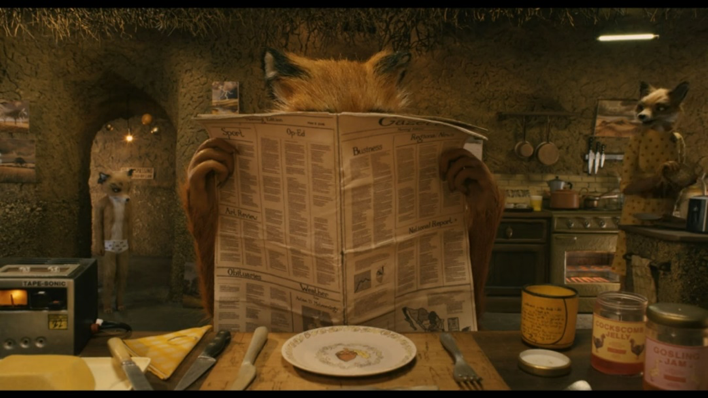
Often in film, what is not being explicitly said through actions or dialogue, provides more insight to the mood of a scene than anything else. Directors will even take that concept further and through the composition of a scene can tell a story or use it as foreshadowing for a larger event to come. In one of the very first scenes of Fantastic Mr. Fox,we see him at the table, reading the newspaper and waiting to eat breakfast before going to work shown in Figure A1. At first glance this is a very unassuming scene the dialogue with his wife is fairly generic, Fox is discontent with his job and life while being mildly interrupted by their son. However, when the composition of the scene is broken down the entire conflict of the story can be glimpsed before the action even begins.
Firstly, the shot puts Mr. Fox directly in the middle both the frame and his wife and child. On the left-hand side of Mr. Fox, there is an excessive number of knives on the table alongside a music player and on the wall, we see three pictures of thunderstorms. Viewing them as a concept of what they represent, they can be labeled under the categories of excitement, danger, and wild. On the right-hand side of Mr. Fox, the objects that stand out the most are two different types of jam, a cozy-looking kitchen, and a painting of a peaceful looking hillside. Doing the same as before these objects can be labeled as almost the exact opposite of left-hand side objects. The multiple jam jars representing dullness, the kitchen representing security, and the calm hillside showing tameness. In addition to the objects shown on the left and the right sides of the frame are the 2 people most involved in his life standing in the very center of both halves respectively almost like cherubs. It’s also worth noting that both have a light source hanging above their head. On the right is a large fluorescent light tube the type of light that creates a gentle soft light, conveying a feeling of peacefulness and comfort; all things in the half frame are reflective of what Felicity herself wants in life. On the left-hand side of the frame, we see a single small lightbulb which above Ash’s head is very similar to that of the “Idea Lightbulb” from older cartoons which highlights a moment a character was about to have a clever solution to a problem. A small bright light also casts defined shadows, conveying often a dangerous feeling and or one of excitement. In addition to all that it is also like that of the sun’s light, uncoincidentally when looking closely one can see a solar system model hanging around the lightbulb. Everything about the right-hand side of the frame is what Ash wants out of life, he aspires to be recognized, creative and athletic.
The last thing worth noting about this scene is that when viewed in complete, including both the dialogue and mise-en-scene is that while Mr. Fox has two clear sides of his life, he seems to exclusively be participating in one half almost completely neglecting the other. For one, Ash certainly has a smaller stature then Felicity and leaves the shot several times. Also, while Mr. Fox has a conversation with his wife, he seems to almost entirely ignore his son’s comments in addition to his wife’s interaction with his son making extremely generic remarks about their conversation. To top it off, when he is leaving for work, he notices his son wearing a pajama-like costume and asks what and why is he wearing that. Ash is mimicking the style of Whitecape, a comic book superhero which he seems to be a big fan of. It’s shown in a later scene that Ash has several posters of Whitecape within his room this poses the question whether Mr. Fox has ever even been in his own son’s room. Emphasizing just how much Mr. Fox is both removed from his old wild lifestyle and therefore also unfortunately detached from his own sons’ life.
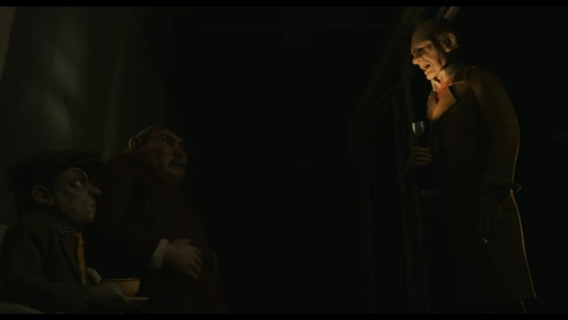
Another basic use of cinematography is a combination of light and color. Used when the farmers are plotting their revenge against Mr. Fox, the primary antagonist, Mr. Bean, is just barely visible among the shadows he sits in with a light behind him providing a hard and crisp outline of his head but not much of his face, the other two farmers are shown in a slightly softer light but still overall very dark with lots of shadows. As the scene progresses Mr. Bean gets up and shoots all the lights, resulting in complete darkness until finally he turns on a flashlight and like fireside ghost storytelling’s, illuminates his face with the flashlight as he tells of his plan to kill the fox at hand shown in figure B1. In addition to the spooky shadows and generally frightening lighting of the villain at this point, this scene is also shot from a very low angle. This creates once again a larger than life statue of an antagonist
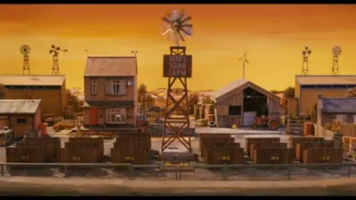
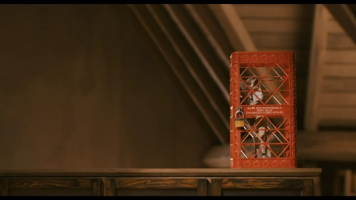
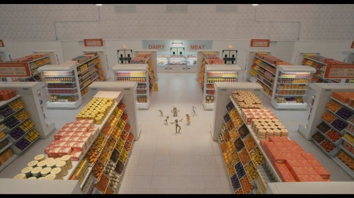
The final and perhaps most obvious cinematographic element of this film is its striking symmetry; however, it is more important to the plot and development of the story when there is a lack of symmetry. Figure C1-3 show a selection of scenes throughout the movie, the first being one of the very first shots of the movie, the farmhouses all in perfect, squab coops, even the chain link fence, and windmills are all in perfect symmetry. However, the hole that Mr. Fox and his family are living in is shown on the outside to be not symmetrical, whereas the tree they are moving into is. The film follows a very simple rule, but it is quite effective in creating a look and sort of stylizing the movie while also subtly reinforcing the action and dialogue happening on screen. The last few screenshots of the movie in C1 shows just how disorganized and asymmetrical the movie becomes before finally ending in a perfectly symmetrical shot in a grocery store with the characters celebrating their newfound source of unlimited food.
In the end, one doesn’t really need impeccable cinematography to make a good film or even a great film. However Fantastic Mr. Fox showcases that when there is great cinematography it’s possible to tell a story in the way that only film can really deliver. Being able to accent minute details and frame scenes in a way that wholly benefits the way that the audience on a subconscious level connects with the characters in the film creates a more powerful experience and undeniably better film.
 Grant's Entertainment Review